Editor-in-Chief Lecture
Author
Associate Professor of Sociology, Institute for Cultural, Social and Civilization Studies, Tehran, Iran
Abstract
The second issue of "The Iranian Journal of University Studies" is dedicated to prehistory and history of universities in Iran. Previously, several papers were written on the subject by prominent researchers in the fields of history, sociology and political thought. However, most of them were compiled with the historiographical approach. This time, we have tried to publish articles that have considered approaches beyond historiography, theory-based interpretation of the events surrounding historical contexts and conditions leading to the emergence and movement of universities. I consider this to be an alternative approach in narrating the history of universities in Iran, an approach where institutional, cultural and social history has been taken into account. And in its narration, the influential moments of this and similar institutions are depicted in the process of social, cultural and political evolution of the Iranian society . Like the first issue, we again publish the articles by renowned professors of sociology, history, higher education and philosophy. As you know how difficult it is to maintain the quality of a scientific journal by publishing original works of renowned and thoughtful professors. However, with the support of the esteemed directorate of the Institute of Cultural, Social and Civilization Studies as well as our dear professors, we have managed to publish valuable articles in this issue as well.
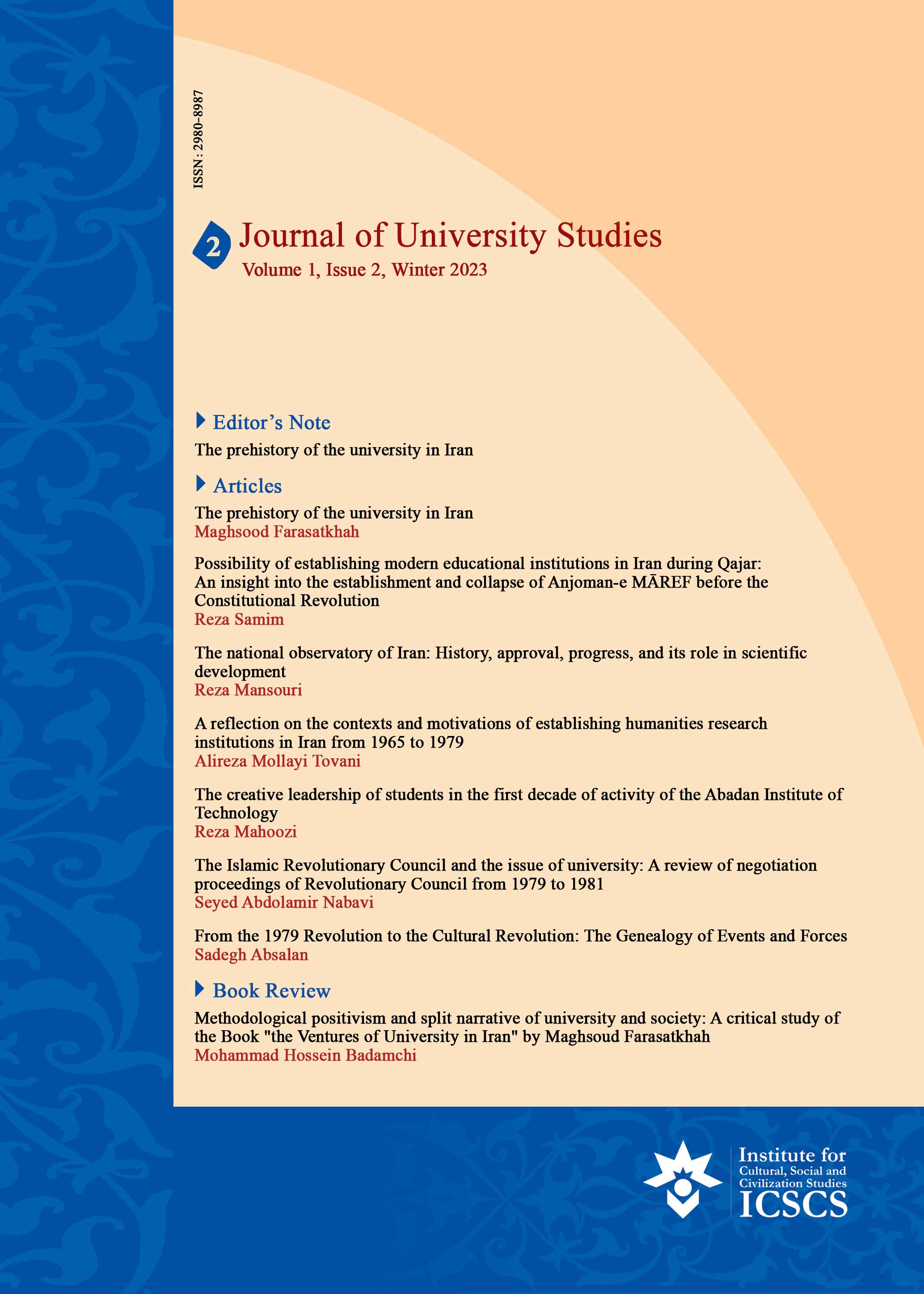
The first two papers deal with the prehistory of the university in Iran. In the first, Professor Maghsoud Farasatkhah has discussed the historicity of universities in Iran through meta-analysis of previous studies by other researchers. He concludes that the university in Iran was a social domain before it could be a historical one. It is a phenomenon that arose from the objective transformation of the Iranian society prior to the Constitutional Revolution. In the second article, I, myself, talk about the legal conditions for the possibility of establishing modern educational institutions before the emergence of a university in Iran. The paper focuses on the fact that in the absence of such a scenario before and on the eve of the Constitutional Revolution, Tehran University would not have emerged as a modern educational institution in the following years. In this article, I have tried to deal with the experience of the establishment and collapse of Anjoman-e-Ma’aref as a modern institution in the field of education in the years before the Constitutional Revolution. It seems that the pattern governing its collapse can be seen as the constantly repeating pattern for the crumbling of all modern educational institutions in contemporary Iran.
In another article, Professor Reza Mansouri has examined the history of the emergence and development of the National Observatory of Iran as a grand plan for scientific development. The author believes that the socio-historical narrative of our macro national plan helps in policy making and correcting the processes in this field. In another article, Professor Alireza Mollayi Tovani has investigated the contexts and motivations of establishing humanities research institutions in Iran from 1965 to 1979. This historical period witnessed the proliferation of educational and research institutions in contemporary Iran. In other words, many universities and research institutes were then emerged and therefore, examining the history of this period is very important. The author concludes that the establishment of humanities research institutions in the last 13 years of the Pahlavi era was the result of a complex development process in Iran and its destructive effects on social and political stability. In another article, Reza Mahoozi focuses on the history of Abadan Faculty of Petroleum as a college with a specific mission. This article is considered important since there is still no coherent historical narrative about Abadan Petroleum College as a strategic institution. Another significance of this paper is that it shows how valuable cultural and social activities, especially among students, were inside a technical college with specific goals. Another article is by Seyed Abdolamir Nabavi about one of the most important periods in the history of university in contemporary Iran, i.e. between 1979 and 1981. He historically examines the issue of the university during the meetings of the Revolutionary Council. In other words, he tries to highlight the stances of important figures toward universities that were inherited from the Pahlavi era. In the last scientific article of this issue, Sadegh Absalan defies the common and obvious idea that the Cultural Revolution was the logical result of changes caused by the Islamic Revolution and its victory. Using the method of historical genealogy, he comes to the conclusion that what university has been encountering today in Iran is the result of conflicting and opposing forces, which have different interests and goals, rather than arising from general rationality and subject to specific necessity in post-revolution Iran.
As I had pointed in my note for the first issue, the Journal of University Studies wishes to publish critical reviews of important works in the field of university studies. With the same milieu, Mohammad Hossein Badamchi has written a review on the important and influential book entitled The Venture and Historicity of University in Iran by Professor Maghsoud Farasatkhah. In this review, he points out a fundamental split, in terms of methodology and epistemology, which governs the author's historical narrative of the emergence and development of university in Iran.